
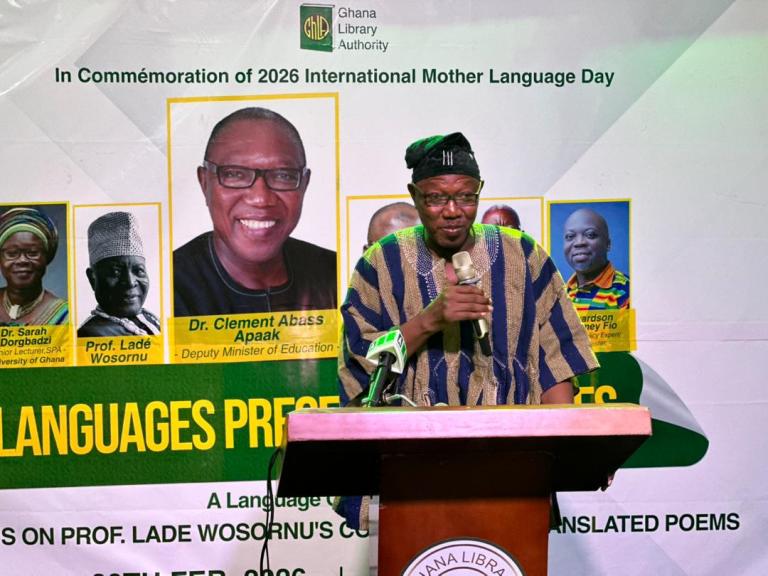
The Deputy Minister of Education Dr. Clement Abas Apaak, has called for stronger support for mother tongue instruction, saying language underpins identity, cognition, and national development.
Delivering the opening remarks at a language conversation organised by the Ghana Library Authority to commemorate International Mother Language Day 2026, Dr. Apaak stressed that language must be treated as a strategic national asset.
“Language is not merely a tool for communication; it is the foundation of cognition, identity, and cultural continuity,” he said.
He noted that research consistently demonstrates that children learn best when taught in a language they understand.
“It is for this reason that the Ministry of Education continues to prioritize mother tongue-based instruction at the foundational level (KG to Primary 3), while introducing English and other international languages as subjects,” he explained.
Dr. Apaak further disclosed that the Ministry, working with the Bureau of Ghana Languages and academic institutions, is advancing the translation of core instructional materials, particularly in Mathematics and Science, into selected Ghanaian languages.
“This initiative is designed to improve learning outcomes, reduce early-grade learning poverty, and promote equity in education delivery,” he said.
Beyond classroom instruction, he highlighted efforts by the Ghana Education Service to promote Ghanaian languages through inter-school competitions featuring renditions of the national anthem and pledge in local languages.
“These efforts are aimed at deepening civic consciousness and making national values more accessible and meaningful to learners,” he added.
He therefore called on parents, educators, publishers and development partners to actively support the use of indigenous languages in homes, schools and public discourse, stressing that policy commitment alone is insufficient without collective action.
“As we mark this important day, let us move beyond celebration to action by investing in language development, supporting research, and integrating indigenous knowledge systems into our education framework,” he urged.






Leave a Reply